Saturday, 21 December 2013

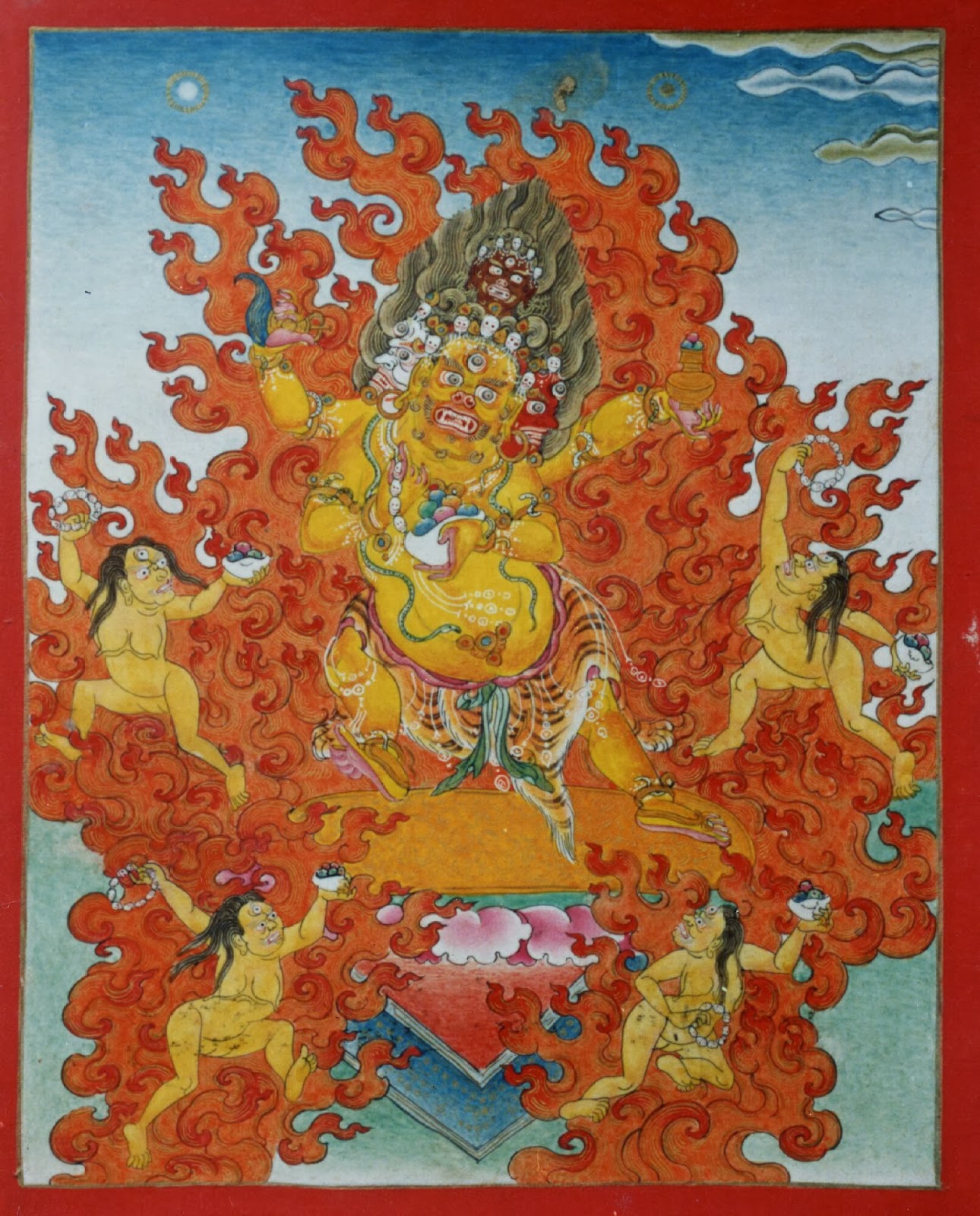
Danda Mahakala (Stick) 衮波措达大黑天


宁玛巴的九大护法 (三)黑大阴阳护主(俗称二臂阴阳玛哈嘎啦)

 
Danda Mahakala (Tibetan: gon po beng leg den nag po sri me gyi bu): a main wisdom protector of the Nyingma School.

Wrathful, black in colour, with one face and two hands he holds upraised in the right a sandalwood staff and a skullcup held to the heart in the left. Wearing a long black cloak he stands atop a corpse seat, sun disc and lotus blossom, surrounded by the flames of wisdom.

(三)黑大阴阳护主(俗称二臂阴阳玛哈嘎啦)
1.姓:罗叉
2.化身:金刚手菩萨之化身
3.承诺之对象:法身普贤王如来、报身金刚萨埵、化身释迦牟尼佛
4.承诺之事业:永远保护佛法,利益众生,特别是保护无二续之佛法。兼任息、增、怀、诛四事业。无二续无男女之别,故称阴阳护主。无上瑜珈密分男续玛哈瑜珈,女续阿努瑜珈,无二续阿底瑜珈(无男女之分)。
5.修行之成就:十地菩萨之果位


Chaturmukha (Four-faces) Mahakala


Mahakala: Chaturmukha (Four-faced)

 
Mahakala, Chaturmukha (Four-faced Great Black One) associated with the Guhyasamaja Tantra along with the Twenty-five and Fifty Chapter Mahakala Tantras. There are also Nyingma Revealed Treasure Traditions (terma) of Chaturmukha.

According to the Sakya Tradition this form of Mahakala with four faces and four arms is rarely depicted in art and virtually never shown to those who are uninitiated. The early Sakya Teachers devised a simplified form of the deity to be depicted on paintings as a place card-holder for the true image and form which was considered too secret and dangerous to display publicly. The simplified form is that of what has come to be known as Brahmanarupa Mahakala. (See below for a short history).

"Shri Vajra Chaturmukha Mahakala, the main face and the stacked face are both black, the two on the right and left are dark green. With four arms, the first two right and left hold a curved knife and blood filled skullcup to the heart. The lower right [holds] a sword. The lower left holds upraised a bone garland [of beads]. The brown hair bristles upwards; there are three eyes, bared fangs, lower lip distended, a crown of five dried skulls, a necklace of fifty fresh [heads], a brahmin's cord, bone and snake ornaments. [He] stands in a manner with the right leg bent and the left straight; having an appearance of magnificent wrathfulness. On the right is black Dombini, left green Chandali, front red Rakshasi, behind yellow Singhali." (by Ngorchen Konchog Lhundrup (1497-1557). Lamdre Collection, vol.18, folios 375-398. sGrub Thabs Kun bTus, vol.10., fol. 400-422. Gyu De Kun Tus, vol.18, fol.128-150).
Chaturmukha also has a number of different variations in form and function. His body colour can change according to activity such as white for long-life, yellow for wealth and red for power. The objects in the hands can change and the colours of the four dakinis along with their hand objects can change. There is also a form of Chaturmukha that has four demon heads. Most commonly these variations in form are only found as depictions in sets of Initiation Cards.

A Short History of Chaturmukha & Brahmanarupa Mahakala: When the great Tibetan Translator Nyen Lotsawa received the Manjuvajra Guhyasamaja (also known as the Jnanapada Lineage) empowerment from the dakini Risula, she also bestowed the initiation of the Mahakala (Chaturmukha) in the special form according to the Guhyasamaja Tantra. At this time she gave him as a servant a dark skinned Brahman. When Nyen Lotsawa and the Brahman reached Nepal the servant changed appearance and took on the form of a monk, an appearance more conducive for travelling in Tibet. After the passing of Nyen Lotsawa the monk remained with Lama Nam Ka'upa and then later with Sachen Kunga Nyingpo.
Brahmanarupa Mahakala is none other than Chaturmukha Mahakala of the Guhyasamaja Tantra. In his wrathful appearance he is black in colour with four faces and four hands, surrounded by the four dakinis. In the Sakya School it is inappropriate to show the wrathful form to anyone who has not received the initiation. For this reason the iconographic tradition arose for painting Chaturmukha in the form of the Brahman servant of Nyen Lotsawa. At the bottom of many Sakya paintings it is a common theme to see Panjarnata Mahakala flanked by the Brahman on the right and Shri Devi (Palden Lhamo) on the left - the three main protectors of the Sakya School.

In later times the Gelug School of Tsongkapa adopted the Guhyasamaja practices and the Chaturmukha Mahakala. Many more paintings and depictions of the four faced deity were made and less emphasis was placed on secrecy. The vast majority of Tibetan and Mongolian paintings of Chaturmukha are Gelugpa.

Indian Lineage: Vajradhara, Nagarjuna, Balimtapa, Buddhajnana, Marmedze Zangpo, Shrideva, Drime Bepa, Ratnavajra, Ratnakirti, Risula Dakini, Nyen Lotsawa, Lama Nam Ka'upa, Sachen Kunga Nyingpo, etc.

Taranata in his text called an Ocean of Meditational Deities (Yidam Gyatso) describes Chaturmukha Mahakala as having Five types: 1. Approximation, 2. Accomplishment, 3. Performing Activities, 4. the Four Families, or Four Activities, and 5. Demon Faces. The technical descriptions of the various forms of Chaturmukha vary between the text of Taranata and the Rinjung Lhantab text of the 4th Panchen Lama.

Chaturmukha Iconographic Forms:

1. Approximation: 40575, 202142
The center face is blue and upper face smokey. The right and left faces are green. The 4th Panchen describes the right face as green and the left face as black.

2. Accomplishment:
The center face is blue and upper face smokey. The right face is white and the left red.

3. Performing Activities: 40577, 202144
The center face is blue and upper face smokey. The right face is white and the left red. The tradition of the 4th Panchen Lama teaches two blue stacked faces on the right and two green stacked faces on the left. (See example).

4. Long-life: 40578, 202145
The form is white in colour along with four white dakinis.

5. Wealth: 40579, 202146, 81673
The form is yellow in colour along with four yellow dakinis.

6. Power: 40580, 202147, 81672
The form is red in colour along with four red dakinis.

7. Practicing Liberation: 40581, 202148, 81671
the form is dark blue in colour and the four dakinis are dark blue each holding a sword in the right hand.

8. Demon Faces: 40582, 48117, 202149
The four faces are of a wrathful figure, elephant, buffalo and a lion. This form of Chaturmukha has six arms.

9. Chaturmukha (Nyingma Treasure Tradition [terma]): 3314575
This form is essentially the same as the Accomplishment Chaturmukha except with the addition of wings.

10. Chaturmukha (Nyingma Treasure Tradition [terma]): 52512
This form is essentially the same as the Accomplishment Chaturmukha except with the addition of a consort and wings.